
Shiva
शिव
Shiva is the supreme deity of the Trimurti who embodies the cosmic functions of destruction and transformation, clearing the way for new creation. Known as Mahadeva (the Great God), he is both the fierce ascetic meditating on Mount Kailash and the loving householder devoted to his consort Parvati. Shiva transcends dualities, being simultaneously the destroyer and the benefactor, the terrifying Rudra and the gentle Bholenath. His devotees revere him as the ultimate reality — Brahman itself — the formless, limitless, unchanging absolute that pervades all of existence.
Iconography & Appearance
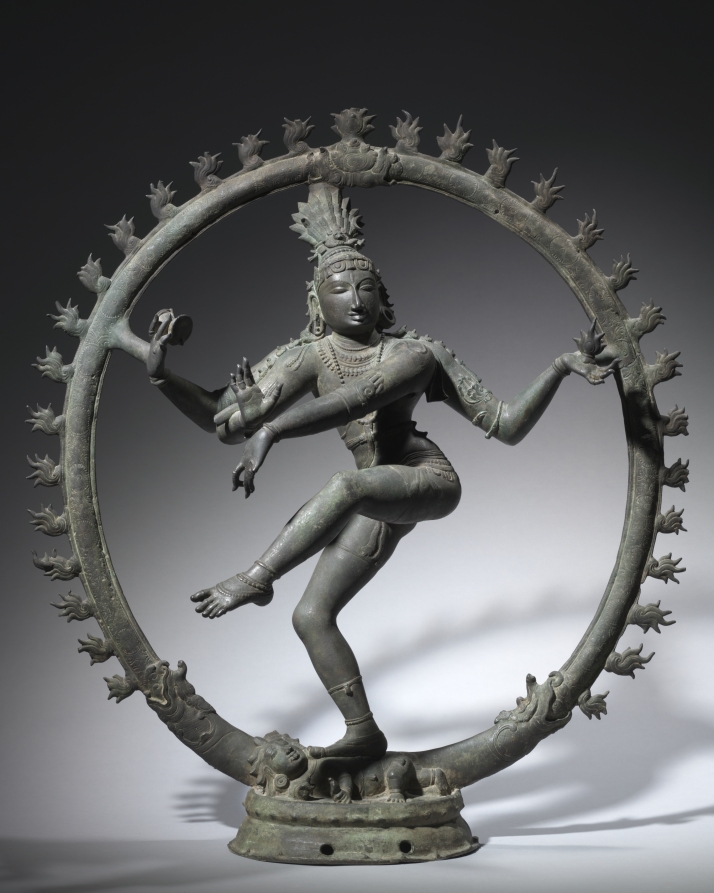
Shiva is commonly depicted with a blue throat (Neelakantha) from swallowing the cosmic poison Halahala, matted locks (jata) from which the Ganges flows, a crescent moon adorning his hair, and a third eye on his forehead representing inner wisdom and the destruction of ignorance. He wears a garland of serpents, particularly Vasuki around his neck, and is often shown seated in deep meditation or performing the cosmic dance Tandava as Nataraja. The trident (trishula), damaru (drum), and the bull Nandi as his vahana complete his iconic representation.
Key Stories & Legends
Shiva Drinks the Cosmic Poison (Samudra Manthan)
During the churning of the cosmic ocean (Samudra Manthan) by the devas and asuras, a deadly poison called Halahala emerged that threatened to destroy all of creation. None among the gods or demons could withstand its potency, so they turned to Shiva for help. Shiva compassionately drank the entire poison, but Parvati pressed his throat to prevent it from reaching his stomach, turning his throat blue and earning him the name Neelakantha. This act of supreme sacrifice demonstrated Shiva's role as the protector of the universe, willing to endure suffering for the welfare of all beings.
The Descent of the Ganges
King Bhagiratha performed severe penance to bring the celestial river Ganges to earth to liberate the souls of his ancestors. However, the force of Ganga's descent from heaven would have shattered the earth. Shiva agreed to break her fall by catching the mighty river in his matted locks, releasing her gently in streams across the land. This story illustrates Shiva's benevolence and his role as the bridge between the celestial and terrestrial realms.
Ardhanarishvara — The Half-Male, Half-Female Form
To demonstrate the inseparability of masculine and feminine principles in creation, Shiva manifested as Ardhanarishvara, a form that is half Shiva and half Parvati. This form illustrates that Shakti (the feminine creative energy) and Shiva (pure consciousness) are not separate but are two aspects of the same ultimate reality. The sage Bhringi, who had refused to worship Parvati, was humbled when Shiva revealed this composite form. Ardhanarishvara teaches that wholeness comes from the union of complementary forces, and neither the masculine nor the feminine is complete without the other.
Sacred Mantras
I bow to Lord Shiva. This Panchakshari mantra is one of the most powerful mantras in Hinduism, invoking the grace and blessings of Shiva.
We worship the three-eyed Lord Shiva who nourishes and spreads fragrance. May he liberate us from the bondage of death, just as a ripe cucumber is released from its vine, and grant us immortality.
I bow to the one who is white as camphor, the incarnation of compassion, the essence of the world, who wears the king of serpents as a garland, and who always dwells in the lotus of the heart along with Bhavani (Parvati).