
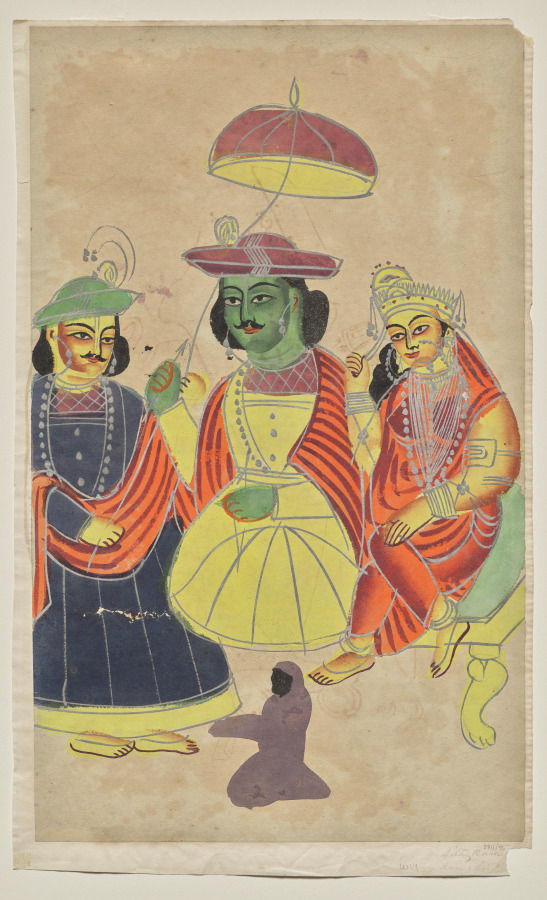
Rama
राम
Rama is the seventh avatar of Vishnu, revered as the embodiment of dharma and the ideal man (Maryada Purushottam). His life story, narrated in the epic Ramayana composed by Sage Valmiki, presents the model of the perfect son, husband, brother, and king who upholds righteousness even at tremendous personal cost. Exiled from his kingdom for fourteen years, Rama faced the abduction of his wife Sita by the demon king Ravana, leading to an epic war in Lanka that demonstrated the ultimate triumph of good over evil. His story has profoundly shaped Indian civilization, ethics, governance, and spiritual practice for millennia, inspiring devotion across South and Southeast Asia.
Iconography & Appearance
Rama is depicted as a noble, handsome prince with a dark green or blue complexion, holding a magnificent bow (Kodanda) and arrows, symbolizing his role as the supreme warrior-protector. He is typically shown alongside his faithful wife Sita, devoted brother Lakshmana, and the loyal Hanuman kneeling in devotion at his feet. In royal depictions, he wears a crown and royal ornaments befitting a prince of the Ikshvaku dynasty of Ayodhya. His calm and composed expression reflects his unwavering commitment to dharma regardless of circumstances.
Key Stories & Legends
The Exile and Abduction of Sita
On the eve of his coronation as king of Ayodhya, Rama was exiled to the forest for fourteen years due to a promise his father King Dasharatha had made to Queen Kaikeyi. Rama accepted the exile without protest, embodying the ideal of filial duty, and was accompanied by Sita and Lakshmana. In the forest, the demon king Ravana, enchanted by Sita's beauty and seeking revenge, abducted her through a deceptive trick involving a golden deer. This event set in motion the great war between Rama and Ravana, which would become the central conflict of the Ramayana.
The Battle of Lanka
With the help of Hanuman and the Vanara (monkey) army led by Sugriva, Rama built a miraculous bridge across the ocean to reach Lanka and rescue Sita. The ensuing battle was fierce, with powerful warriors on both sides clashing in extraordinary combat. Rama ultimately faced Ravana in single combat and, guided by the sage Agastya's invocation of the Aditya Hridayam hymn, slew the ten-headed demon king with a celestial arrow to the heart. The victory of Rama over Ravana is celebrated as Dussehra, and his triumphant return to Ayodhya is the festival of Diwali, the festival of lights.
Rama Rajya — The Ideal Kingdom
After returning to Ayodhya and being crowned king, Rama established Rama Rajya, an era of perfect governance, justice, and prosperity that became the gold standard for ideal rule in Hindu civilization. During his reign, there was no poverty, disease, or injustice; all people lived in harmony and followed dharma. Rama treated every citizen with equal care and was accessible to even the humblest subject. The concept of Rama Rajya has since become a powerful ideal in Indian political and moral thought, representing a governance model where the ruler puts the welfare of the people above all personal desires.
Sacred Mantras
Salutations to the auspicious Lord Rama, the source of all bliss and righteousness.
Glory to Lord Rama, victory to Rama, victory, victory to Rama. This mantra, popularized by Saint Samarth Ramdas, is a celebration of Rama's divine victory over evil.
Salutations to Rama, the gentle Rama, Ramachandra the creator, the lord of the Raghu dynasty, the supreme lord and the consort of Sita.