
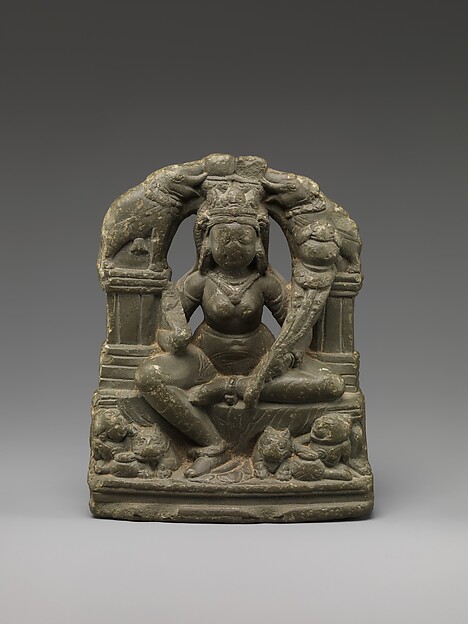
Lakshmi
लक्ष्मी
Lakshmi is the Hindu goddess of wealth, fortune, prosperity, beauty, and abundance in both the material and spiritual realms. As the consort of Vishnu, she accompanies him in each of his incarnations — as Sita with Rama, as Rukmini and Radha with Krishna — embodying the grace and nurturing energy that sustains creation. She emerged from the churning of the cosmic ocean (Samudra Manthan) in radiant beauty, choosing Vishnu as her eternal consort. Lakshmi represents not merely material wealth but the richness of a fulfilled life, including spiritual wealth, health, knowledge, and the prosperity that comes from righteous living.
Iconography & Appearance
Lakshmi is depicted as a beautiful golden-complexioned goddess dressed in a red sari embroidered with gold, symbolizing prosperity, fertility, and auspiciousness. She is shown seated or standing on a fully bloomed pink lotus, with four arms representing the four goals of human life: dharma, artha (wealth), kama (desire), and moksha (liberation). Two of her hands shower gold coins symbolizing material blessings, while the other two hold lotuses. She is often flanked by white elephants showering her with water, representing royal power, fertility, and abundance.
Key Stories & Legends
Lakshmi Emerges from the Ocean of Milk
During the Samudra Manthan (churning of the cosmic ocean), Lakshmi emerged from the milky waters standing on a lotus in full bloom, radiating beauty and divine grace that illuminated all three worlds. Both the devas and asuras were entranced and desired her, but Lakshmi placed her garland around Vishnu's neck, choosing him as her eternal consort. She brought with her the Kaustubha gem and other treasures from the ocean. This emergence symbolizes that true prosperity arises from sustained effort (the churning) and naturally gravitates toward righteousness and virtue (Vishnu).
Lakshmi and the Story of Ashta Lakshmi
Lakshmi manifests in eight primary forms known as Ashta Lakshmi, each representing a different aspect of prosperity essential for a complete and fulfilled life. Adi Lakshmi (the primeval), Dhana Lakshmi (wealth), Dhanya Lakshmi (grain and food), Gaja Lakshmi (power and royal authority), Santana Lakshmi (progeny), Veera Lakshmi (courage), Vijaya Lakshmi (victory), and Vidya Lakshmi (knowledge and education). These eight forms are especially worshipped during Diwali and Navaratri. The concept teaches that true prosperity encompasses far more than money — it includes health, knowledge, courage, family, and spiritual well-being.
Lakshmi's Vow of Faithfulness
According to the Vishnu Purana, Lakshmi once left Vishnu's abode due to a curse and incarnated on earth, living as a devoted wife in humble circumstances. Vishnu incarnated to be with her, and through their earthly trials, Lakshmi demonstrated that her devotion transcended heavenly comforts. She is said to be ever-present wherever there is righteousness, cleanliness, generosity, and devotion. However, she departs from places of dishonesty, laziness, filth, and ingratitude, which is why Hindu tradition emphasizes keeping homes clean and orderly to welcome her blessings.
Sacred Mantras
Salutations to the great Goddess Lakshmi. The bija (seed) mantra Shreem invokes her energy of abundance, beauty, and grace.
O auspicious one, who grants all that is good, who is the consort of Shiva, who fulfills all purposes, who is the refuge of all, the three-eyed, fair-complexioned Narayani — I bow to you.
O Lakshmi, who resides in the lotus, be pleased, be pleased. Salutations to the great Goddess Lakshmi. This mantra invokes all forms of material and spiritual prosperity.