
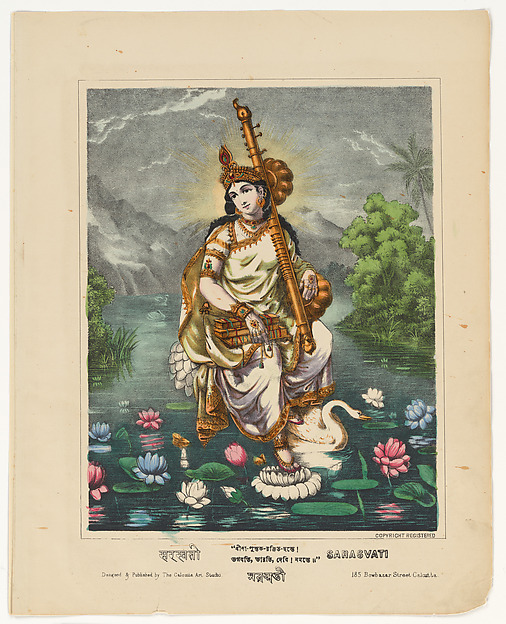
Saraswati
सरस्वती
Saraswati is the Hindu goddess of knowledge, music, arts, speech, wisdom, and learning, revered as the embodiment of intellectual and creative power. As the consort of Brahma, she represents the knowledge and wisdom necessary to bring order and meaning to creation. Unlike other deities adorned with gold and jewels, Saraswati is dressed in pure white, signifying the purity of true knowledge that transcends material attachment. She is the patroness of students, scholars, artists, musicians, and anyone engaged in the pursuit of knowledge, and her blessings are sought before beginning any educational or creative endeavor.
Iconography & Appearance
Saraswati is depicted as an ethereally beautiful goddess dressed in white, seated on a white lotus or sometimes on a swan, playing the veena (a stringed musical instrument) that represents mastery over all forms of arts and knowledge. She has four arms holding a veena, a pustaka (book of knowledge, often the Vedas), a mala (crystal rosary representing meditation and spirituality), and sometimes a kamandalu (water pot representing purifying power). Her white sari, white lotus, and white swan all symbolize sattva — purity, truth, and the transcendence of worldly illusions.
Key Stories & Legends
Saraswati and the Gift of Language
After Brahma created the universe, there was chaos because beings could not communicate, organize, or make sense of creation. Brahma called upon his creative power, and from him emerged Saraswati, who brought with her the gift of language, alphabet, grammar, and the ability to express ideas. She taught the devas and humans the arts of communication, music, and structured thought. With her blessings, civilization flourished as beings could now share knowledge, create art, compose hymns, and pass wisdom from generation to generation, transforming chaos into ordered, meaningful existence.
Saraswati and the Demon Kumbhakarna
When the demon Kumbhakarna performed severe penance to obtain a boon from Brahma, the gods feared he would ask for "Indrasana" (the throne of Indra), making him invincible. At the request of the devas, Saraswati sat on Kumbhakarna's tongue and altered his speech so that he instead asked for "Nidrasana" (a bed for sleeping). This boon caused Kumbhakarna to sleep for six months at a time, neutralizing his tremendous power. The story illustrates Saraswati's control over speech and the immense power of words — how a single syllable can change the course of destiny.
The River Saraswati
In Vedic tradition, Saraswati is also identified with the sacred Saraswati River, described in the Rigveda as a mighty, life-giving river that nourished the great Vedic civilization. The river flowed through the heartland of ancient India, and its banks were the sites where sages composed the earliest Vedic hymns. Over millennia, the river dried up and became invisible, flowing underground according to tradition. The meeting of the visible Ganga and Yamuna with the invisible Saraswati at Prayagraj (the Triveni Sangam) is one of the holiest confluences in Hinduism, representing the union of devotion, action, and knowledge.
Sacred Mantras
Salutations to Goddess Saraswati. The bija mantra Aim is the seed sound of knowledge and wisdom, invoking Saraswati's blessings for learning and creativity.
Salutations to Saraswati, the bestower of boons, who fulfills all desires. I am beginning my studies; may I always achieve success.
May that Goddess Saraswati, who is white as a jasmine flower, the moon, and snow, who wears pure white garments, whose hand is adorned by the veena, who is seated on a white lotus, who is worshipped by Brahma, Vishnu, and Shiva, protect me and remove all my ignorance and sluggishness.